


Dali – Geopolitical child watches the birth of the new human (Set)
108,00 euro(1943) The new human must free itself from its oppressive entwinement with the past. Height: 12cm
All items in stock
In-store pickup
Order before 12 PM, same-day shipping
Shipped with insurance
Salvador Dali (1904-1989, Figueres) — Spanish surrealist artist, painter, sculptor and filmmaker. Dali is known for his technically virtuosic paintings in which dream imagery, optical illusions and illogical scenes converge into a hyperrealistic fantasy world. His most iconic work is The Persistence of Memory (1931), featuring the world-famous melting clocks. At Pop Art Statues you'll find museum replicas of Dali sculptures, including The Burning Giraffe, The Temptation of Saint Anthony and the Dali elephant.
## Salvador Dali: master of surrealism
Salvador Felipe Jacinto Dali i Domenech was born on 11 May 1904 in Figueres, Catalonia. He displayed artistic talent from an early age; at fourteen he had his first public exhibition. He studied at the Academia de San Fernando in Madrid, where he came into contact with Federico Garcia Lorca and Luis Bunuel. In 1929, he joined the Surrealist movement in Paris and began his collaboration with film director Bunuel, leading to the experimental film Un Chien Andalou.
Dali married Gala (Elena Ivanovna Diakonova) in 1934, who became his muse, manager and recurring subject in his work. The couple lived alternately in Spain, France and the United States. Dali worked not only as a painter but also as a sculptor, writer, filmmaker and designer. He died on 23 January 1989 in his birthplace of Figueres, where his own museum — the Teatro-Museo Dali — is one of Spain’s most visited museums.
## How to recognise Dali’s style
The work of Salvador Dali is recognisable by a number of recurring elements:
– **Hyperrealistically painted dream imagery**: Dali painted surreal scenes using an extremely detailed, almost photographic technique. The contrast between the realistic execution and the impossible subjects makes his work instantly recognisable.
– **Melting and distorted objects**: His best-known visual motif is the **soft clocks** from The Persistence of Memory. Dali depicted solid objects as if they were melting or deforming, as a visual representation of the relativity of time.
– **Elephants on spindly legs**: Dali regularly depicted elephants on long, thin, spindly legs — symbols of **strength on a fragile foundation**. These figures appear in works including The Temptation of Saint Anthony (1946) and Dream Caused by the Flight of a Bee Around a Pomegranate a Second Before Awakening (1944).
– **The paranoiac-critical method**: Dali developed his own creative method in which he deliberately used irrational associations and delusions as a starting point for his compositions. This produced double images and optical illusions that make the work appear different with each viewing.
## Dali collection at Pop Art Statues
At Pop Art Statues, several museum replicas of Salvador Dali are available. These are licensed reproductions of his sculptural work, executed in resin and hand-painted. They are not originals but quality replicas that make Dali’s sculptures accessible for the home.
The collection includes:
– **The Burning Giraffe** (1936-1937) — replica of 19 cm, around 60 euros
– **The Temptation of Saint Anthony** — available as elephant (24 cm, around 74 euros) and as horse
– **The Poetry of America — The Cosmic Athletes** (1943) — replica of 18 cm
– **Portrait of Picasso** — neoclassical portrait with surrealist symbolism, around 44 euros
– **Dali elephant** — based on the iconic spindly-legs motif
Prices range from around 40 to 75 euros, depending on size. All sculptures come with an information card about the original artwork.
## Who is Dali a good gift for?
A Dali replica suits lovers of **surrealism and museum art** who want an artwork that stands out and sparks conversation. The sculptures are suitable as a gift for someone who appreciates unusual, imaginative art — think of a birthday, graduation gift or housewarming. Dali’s work appeals to a broad audience, from art history students to interior enthusiasts looking for an eye-catcher.
Less suitable for those seeking a subtle, understated art object. Dali’s sculptures have a bold presence: the surrealist forms attract attention and do not fit every interior. Those looking for abstract or minimalist art will likely find Dali’s figurative, narrative style too busy.
## Frequently asked questions about Salvador Dali
**What style does Salvador Dali have?**
Salvador Dali was a surrealist artist who depicted dream imagery, optical illusions and unconscious associations using a hyperrealistic painting technique. His work combines technical virtuosity with imaginative, sometimes disturbing subjects. Besides paintings, he created sculptures, films, jewellery and furniture designs.
**Are the Dali sculptures at Pop Art Statues originals?**
No. They are museum replicas: licensed reproductions of Dali’s sculptural work, made of resin. They are intended as affordable art objects for the home, not as investment pieces. The replicas faithfully represent Dali’s sculptures and come with background information about the original work.
**How much do Dali replicas cost at Pop Art Statues?**
Prices range from around 40 to 75 euros, depending on size and the specific sculpture. The Burning Giraffe costs around 60 euros, the large elephant from The Temptation of Saint Anthony around 74 euros. Check the product pages for current prices.
**What is the most popular Dali gift?**
The Burning Giraffe and the Dali elephant on spindly legs are the most recognisable sculptures in the collection. The Burning Giraffe is a compact piece (19 cm) that is instantly recognised as Dali, making it a compelling gift for anyone who loves surrealism.
Showing all 13 resultsSorted by latest

(1943) The new human must free itself from its oppressive entwinement with the past. Height: 12cm

(1944) Design for the balet Mad Tristan, written by Dalí, inspired by the opera Tristan and Isolde by Wagner. Height: 9cm

(1939) Design for the ballet by Leonide Massine, danced on music from Richard Wagner. Height: 9cm

(1944) Freudian image based on a dream from Gala, Dalí’s wife. Height: 17cm

A neo-classical portrait filled with alienating Dalísymbolism. Height: 13,5 cm
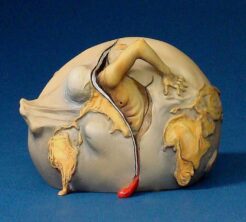
(1943) The new human must free itself from its oppressive entwinement with the past. Height: 5cm

1946) Dali’s nuclear mysticism provokes the laws of gravity. Height: 47cm

(1941) An anti psychological self portrait, the glove of my inner soul. Height: 8cm

The Salvador Dali action figure comes with: Crazy adjustable moustaches. Deluxe moustaches made of stainless steel. His signature melting clock. 5 masterpieces to display on a miniature easel. Transparent base. The Gala-Salvador Dalí Foundation endorses this product. The action figure is 5 centimeters tall and made of PVC. Warning: Choking Hazard. Small parts. This is…

The promise and danger of the new world. (1943) Height: 18cm

Dalí’s nuclear mysticism provokes the laws of gravity. Height: 24cm
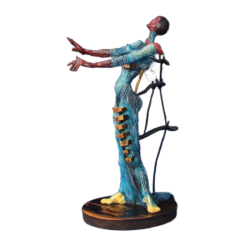
Man is full of secret drawers, only to be opened by psychoanalysis. (1936-1937) Height: 19cm

Dalí’s nuclear mysticism provokes the laws of gravity. Height: 24cm
Salvador Felipe Jacinto Dali i Domenech was born on 11 May 1904 in Figueres, Catalonia. He displayed artistic talent from an early age; at fourteen he had his first public exhibition. He studied at the Academia de San Fernando in Madrid, where he came into contact with Federico Garcia Lorca and Luis Bunuel. In 1929, he joined the Surrealist movement in Paris and began his collaboration with film director Bunuel, leading to the experimental film Un Chien Andalou.
Dali married Gala (Elena Ivanovna Diakonova) in 1934, who became his muse, manager and recurring subject in his work. The couple lived alternately in Spain, France and the United States. Dali worked not only as a painter but also as a sculptor, writer, filmmaker and designer. He died on 23 January 1989 in his birthplace of Figueres, where his own museum — the Teatro-Museo Dali — is one of Spain's most visited museums.
The work of Salvador Dali is recognisable by a number of recurring elements:
Like Rene Magritte and Hieronymus Bosch, Dali created impossible, fantastical scenes. But where Magritte's surrealism is philosophical and Bosch's is medieval-religious, Dali's surrealism is deeply personal and psychoanalytical. Gustav Klimt, from an entirely different tradition, shares Dali's decorative richness and love of symbolism.
At Pop Art Statues, several museum replicas of Salvador Dali are available. These are licensed reproductions of his sculptural work, executed in resin and hand-painted. They are not originals but quality replicas that make Dali's sculptures accessible for the home.
The collection includes:
Prices range from around 40 to 75 euros, depending on size. All sculptures come with an information card about the original artwork.
A Dali replica suits lovers of surrealism and museum art who want an artwork that stands out and sparks conversation. The sculptures are suitable as a gift for someone who appreciates unusual, imaginative art — think of a birthday, graduation gift or housewarming. A Dali sculpture also makes an original birthday or housewarming gift that is guaranteed to spark conversation. Dali's work appeals to a broad audience, from art history students to interior enthusiasts looking for an eye-catcher.
Less suitable for those seeking a subtle, understated art object. Dali's sculptures have a bold presence: the surrealist forms attract attention and do not fit every interior. Those looking for abstract or minimalist art will likely find Dali's figurative, narrative style too busy.
Do you like Salvador Dali? Also check out Rene Magritte, Hieronymus Bosch and Gustav Klimt in our collection.
Salvador Dali was a surrealist artist who depicted dream imagery, optical illusions and unconscious associations using a hyperrealistic painting technique. His work combines technical virtuosity with imaginative, sometimes disturbing subjects. Besides paintings, he created sculptures, films, jewellery and furniture designs.
No. They are museum replicas: licensed reproductions of Dali's sculptural work, made of resin. They are intended as affordable art objects for the home, not as investment pieces. The replicas faithfully represent Dali's sculptures and come with background information about the original work.
Prices range from around 40 to 75 euros, depending on size and the specific sculpture. The Burning Giraffe costs around 60 euros, the large elephant from The Temptation of Saint Anthony around 74 euros. Check the product pages for current prices.
The Burning Giraffe and the Dali elephant on spindly legs are the most recognisable sculptures in the collection. The Burning Giraffe is a compact piece (19 cm) that is instantly recognised as Dali, making it a compelling gift for anyone who loves surrealism.
Dust the sculpture with a soft, dry cloth. Do not use abrasive cleaning products. The replicas are made of resin and are intended for indoor use. Avoid prolonged exposure to direct sunlight.
All items in stock
In-store pickup
Order before 12 PM, same-day shipping
Shipped with insurance