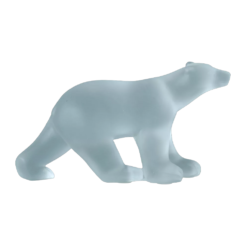
Francois Pompon (1855-1933, Saulieu) — French sculptor, pioneer of modern animal sculpture. Pompon reduced animal forms to their essence: smooth, streamlined volumes without detail, capturing the movement and character of the animal in a minimum of lines. His most famous work is the "Ours Blanc" (Polar Bear), with which he achieved his breakthrough at the age of 67. At Pop Art Statues you'll find museum replicas of Pompon's animal sculptures in various sizes and colours.
## Francois Pompon: the sculptor who simplified animals
Francois Pompon was born in 1855 in Saulieu, in the Burgundy region of France, the son of a furniture maker. At the age of fifteen, he became an apprentice to a tombstone maker in Dijon to learn the basics of sculpting. At the same time, he attended evening classes at the Ecole des Beaux-Arts in Dijon. He later moved to Paris, where he worked by day for a tombstone maker in Montparnasse and studied in the evenings at the Ecole des Arts Decoratifs.
During his studies, Pompon met the animal sculptor Pierre-Louis Rouillard, who would have a lasting influence on his work. Pompon worked for years as an assistant to Auguste Rodin and other established sculptors, a period that shaped him technically but brought little recognition. His breakthrough came only at the age of 67, when in 1922 he exhibited his famous polar bear in plaster at the Salon des artistes francais. The public and critics were enthusiastic. Pompon died in 1933 and left nearly 300 works to the French state, which are now on display at the Musee des Beaux-Arts in Dijon and the Musee d’Orsay in Paris.
## How to recognise Pompon’s style
Pompon’s work is distinguished by a radical simplification that anticipated later art movements:
– **Streamlined volumes**: Pompon eliminated all superfluous details — no fur, no feathers, no texture. What remains are **smooth, flowing surfaces** that reveal the essential form of the animal. A bear is recognisable as a bear by its silhouette, not by its pelt.
– **Stylisation without abstraction**: Although Pompon’s forms are highly simplified, they remain **recognisable and naturalistic**. He observed animals for hours at the Jardin des Plantes in Paris to understand their posture and movement before reducing them to their core.
– **Tension in stillness**: Pompon’s animals stand, sit or walk — they do not leap or fight. Yet there is **movement in their posture**: the polar bear stretches out as if sniffing, the marabou tucks its head in. These are snapshots of everyday animal behaviour, not dramatic scenes.
– **Art Deco avant la lettre**: Pompon’s smooth forms and geometric simplification anticipated the **Art Deco aesthetic** that would emerge in the 1920s. His work is therefore often displayed in an Art Deco context, although it chronologically preceded it.
## Pompon collection at Pop Art Statues
At Pop Art Statues, a broad collection of Pompon replicas is available. These are museum replicas made of resin, based on the originals in the Musee d’Orsay and the Musee des Beaux-Arts in Dijon.
The collection includes replicas of various animals:
– “Ours Blanc” (Polar Bear) — Pompon’s most famous sculpture, available as a replica (around 45 euros). A gold-coloured variant (“Polar Bear Gold”) is also available.
– “Ours Brun” (Brown Bear) — available in a white version (around 55 euros) and a standard version (around 45 euros).
– “Grand Duc” (Eagle Owl) — available in medium and large sizes.
– “Coq Dormant” (Sleeping Rooster).
– “Marabout” (Marabou Stork).
– “Hippopotame” (Hippopotamus).
– “Lapin Courant” (Running Rabbit, around 63 euros).
Prices range from around 45 to 65 euros for most sculptures, depending on animal and size. Check the product pages for current prices.
## Who is Pompon a good gift for?
A Pompon replica suits lovers of **animals, sculpture and clean design**. The streamlined, smooth sculptures fit in both a classical and modern interior — they are decorative without being busy. It is a strong gift for animal lovers who also appreciate art, or for anyone looking for an elegant decorative piece.
Particularly suitable as a gift for someone who is fond of a particular animal: the polar bear for a polar enthusiast, the hippopotamus for a zoo fan, the rabbit for a rabbit lover. The sculptures are also suitable as a housewarming gift thanks to their neutral appearance and broad appeal.
Less suitable for those seeking detailed, naturalistic animal work. Pompon’s sculptures show no fur, no eyes, no individual features — they are archetypes, not portraits. Those expecting a realistic animal sculpture may find the abstraction disappointing. Those looking for colourful art should also bear in mind that Pompon replicas are typically monochrome — white, bronze-coloured or black.
## Frequently asked questions about Francois Pompon
**What style does Francois Pompon have?**
Pompon is regarded as a pioneer of modern animal sculpture. He simplified animal forms into smooth, streamlined volumes without textural detail. His style anticipates Art Deco and is characterised by a combination of naturalistic observation and radical stylisation.
**Are the Pompon sculptures at Pop Art Statues originals?**
No, they are museum replicas made of resin. The original sculptures — partly in bronze, partly in stone — are housed in the Musee d’Orsay in Paris and the Musee des Beaux-Arts in Dijon, where the vast majority of Pompon’s legacy is preserved. The replicas are based on these originals.
**How much do Pompon replicas cost at Pop Art Statues?**
Most Pompon replicas cost between 45 and 65 euros, depending on the animal and size. This makes them the most affordable museum replicas in the range. Check the product pages for current prices.
**What is the most popular Pompon gift?**
The Ours Blanc (Polar Bear) is the most popular Pompon sculpture — it is the work with which Pompon became famous in 1922 and is his most iconic sculpture. It is an elegant, neutral piece that fits in virtually any interior and is widely appreciated as a gift.
(1920 – 33) Acrylic crystal Pompon heeft het grootste deel van zijn leven gewerkt in dienst van andere kunstenaars. Van 1890 tot 1895 was hij chef d’atelier van Rodin, en daarna assisteerde hij tot 1916 René de Saint-Mareaux. Daarnaast bleef hij zoeken naar een eigen stijl, waarbij het opkomende Japonisme en zijn bewondering voor de…
(1920 – 33) Pompon heeft het grootste deel van zijn leven gewerkt in dienst van andere kunstenaars. Van 1890 tot 1895 was hij chef d’atelier van Rodin, en daarna assisteerde hij tot 1916 René de Saint-Mareaux. Daarnaast bleef hij zoeken naar een eigen stijl, waarbij het opkomende Japonisme en zijn bewondering voor de Egyptische kunst…
Artémus & Parastone: Official Pompom Collection Artémus is a publisher for artists and museums. Artémus’ mission statement is: The official François Pompon collection is based on a manifesto that aims to preserve and respect the form and material of François Pompon’s works and to remain true to the spirit of this artist. Artémus has strong…
(1920 – 1933) Pompon spent most of his life working for other artists. From 1890 to 1895 he was chef d’atelier to Rodin, and then he assisted René de Saint-Mareaux until 1916. He also continued to search for his own style, in which the emerging Japonism and his admiration for Egyptian art played a major…
(1920 – 1933) Pompon spent most of his life working for other artists. From 1890 to 1895 he was chef d’atelier to Rodin, and then he assisted René de Saint-Mareaux until 1916. He also continued to search for his own style, in which the emerging Japonism and his admiration for Egyptian art played a major…
This image, created by François Pompon, reflects his signature style of stylized simplicity and elegance. It shows a bird in a resting position, with smooth lines and a reduction of detail, which is typical of Pompon’s work. This style emphasizes the essence and attitude of the animal rather than realistic details. The statue is 4…
The “Grand Duc” sculpture is a refined sculpture of an eagle owl, originally created by the French sculptor François Pompon (1855-1933) between 1927 and 1930. Pompon was known for his stylized animal sculptures, reducing complex shapes to elegant, flowing lines. Height: 10cm
Francois Pompon (1855-1933) Pompon was born in Saulieu in the French Bourgogne as the son of a furniture maker. At age 15 he started working for an undertaker in Dijon, where he learned the basics of sculpting. In the evening he went to l’Ecole des Beaux Arts. Five years later he went to Paris, where…
Francois Pompon (1855-1933) Pompon was born in Saulieu in the French Bourgogne as the son of a furniture maker. At age 15 he started working for an undertaker in Dijon, where he learned the basics of sculpting. In the evening he went to l’Ecole des Beaux Arts. Five years later he went to Paris, where…
Francois Pompon (1855-1933)Pompon was born in Saulieu in the French Bourgogne as the son of a furniture maker. At age 15 he started working for an undertaker in Dijon, where he learned the basics of sculpting. In the evening he went to l’Ecole des Beaux Arts. Five years later he went to Paris, where he…
Francois Pompon (1855-1933)Pompon was born in Saulieu in the French Bourgogne as the son of a furniture maker. At age 15 he started working for an undertaker in Dijon, where he learned the basics of sculpting. In the evening he went to l’Ecole des Beaux Arts. Five years later he went to Paris, where he…
Francois Pompon (1855-1933) Pompon was born in Saulieu in Burgundy, France, the son of a furniture maker. At the age of 15, he joined a funeral director in Dijon, where he learned the basics of sculpting. In the evenings he visited l’Ecole des Beaux Arts. Five years later he left for Paris, where he also…
Francois Pompon (1855-1933) Pompon was born in Saulieu in the French Bourgogne as the son of a furniture maker. At age 15 he started working for an undertaker in Dijon, where he learned the basics of sculpting. In the evening he went to l’Ecole des Beaux Arts. Five years later he went to Paris, where…
Francois Pompon (1855-1933)Pompon was born in Saulieu in the French Bourgogne as the son of a furniture maker. At age 15 he started working for an undertaker in Dijon, where he learned the basics of sculpting. In the evening he went to l’Ecole des Beaux Arts. Five years later he went to Paris, where he…
Francois Pompon: the sculptor who simplified animals
Francois Pompon was born in 1855 in Saulieu, in the Burgundy region of France, the son of a furniture maker. At the age of fifteen, he became an apprentice to a tombstone maker in Dijon to learn the basics of sculpting. At the same time, he attended evening classes at the Ecole des Beaux-Arts in Dijon. He later moved to Paris, where he worked by day for a tombstone maker in Montparnasse and studied in the evenings at the Ecole des Arts Decoratifs.
During his studies, Pompon met the animal sculptor Pierre-Louis Rouillard, who would have a lasting influence on his work. Pompon worked for years as an assistant to Auguste Rodin and other established sculptors, a period that shaped him technically but brought little recognition. His breakthrough came only at the age of 67, when in 1922 he exhibited his famous polar bear in plaster at the Salon des artistes francais. The public and critics were enthusiastic. Pompon died in 1933 and left nearly 300 works to the French state, which are now on display at the Musee des Beaux-Arts in Dijon and the Musee d'Orsay in Paris.
How to recognise Pompon's style
Pompon's work is distinguished by a radical simplification that anticipated later art movements:
Streamlined volumes: Pompon eliminated all superfluous details — no fur, no feathers, no texture. What remains are smooth, flowing surfaces that reveal the essential form of the animal. A bear is recognisable as a bear by its silhouette, not by its pelt.
Stylisation without abstraction: Although Pompon's forms are highly simplified, they remain recognisable and naturalistic. He observed animals for hours at the Jardin des Plantes in Paris to understand their posture and movement before reducing them to their core.
Tension in stillness: Pompon's animals stand, sit or walk — they do not leap or fight. Yet there is movement in their posture: the polar bear stretches out as if sniffing, the marabou tucks its head in. These are snapshots of everyday animal behaviour, not dramatic scenes.
Art Deco avant la lettre: Pompon's smooth forms and geometric simplification anticipated the Art Deco aesthetic that would emerge in the 1920s. His work is therefore often displayed in an Art Deco context, although it chronologically preceded it.
Like Edgar Degas, Pompon was trained in the studio of Auguste Rodin, where he absorbed the master's technique before developing his own radically different style. Lisa Larson shares his love of simplified, rounded animal forms. Salvador Dali, from a completely different tradition, shares Pompon's ability to distil complex forms into essential shapes.
Pompon collection at Pop Art Statues
At Pop Art Statues, a broad collection of Pompon replicas is available. These are museum replicas made of resin, based on the originals in the Musee d'Orsay and the Musee des Beaux-Arts in Dijon.
The collection includes replicas of various animals:
"Ours Blanc" (Polar Bear) — Pompon's most famous sculpture, available as a replica (around 45 euros). A gold-coloured variant ("Polar Bear Gold") is also available.
"Ours Brun" (Brown Bear) — available in a white version (around 55 euros) and a standard version (around 45 euros).
"Grand Duc" (Eagle Owl) — available in medium and large sizes.
"Coq Dormant" (Sleeping Rooster).
"Marabout" (Marabou Stork).
"Hippopotame" (Hippopotamus).
"Lapin Courant" (Running Rabbit, around 63 euros).
Prices range from around 45 to 65 euros for most sculptures, depending on animal and size. Check the product pages for current prices.
Who is Pompon a good gift for?
A Pompon replica suits lovers of animals, sculpture and clean design. The streamlined, smooth sculptures fit in both a classical and modern interior — they are decorative without being busy. It is a strong gift for animal lovers who also appreciate art, or for anyone looking for an elegant decorative piece.
Particularly suitable as a gift for someone who is fond of a particular animal: the polar bear for a polar enthusiast, the hippopotamus for a zoo fan, the rabbit for a rabbit lover. The sculptures are also suitable as a housewarming gift thanks to their neutral appearance and broad appeal. A Pompon replica makes a fitting housewarming or birthday gift for anyone who loves animals and elegant design.
Less suitable for those seeking detailed, naturalistic animal work. Pompon's sculptures show no fur, no eyes, no individual features — they are archetypes, not portraits. Those expecting a realistic animal sculpture may find the abstraction disappointing. Those looking for colourful art should also bear in mind that Pompon replicas are typically monochrome — white, bronze-coloured or black.
Pompon is regarded as a pioneer of modern animal sculpture. He simplified animal forms into smooth, streamlined volumes without textural detail. His style anticipates Art Deco and is characterised by a combination of naturalistic observation and radical stylisation.
Are the Pompon sculptures at Pop Art Statues originals?
No, they are museum replicas made of resin. The original sculptures — partly in bronze, partly in stone — are housed in the Musee d'Orsay in Paris and the Musee des Beaux-Arts in Dijon, where the vast majority of Pompon's legacy is preserved. The replicas are based on these originals.
How much do Pompon replicas cost at Pop Art Statues?
Most Pompon replicas cost between 45 and 65 euros, depending on the animal and size. This makes them the most affordable museum replicas in the range. Check the product pages for current prices.
What is the most popular Pompon gift?
The Ours Blanc (Polar Bear) is the most popular Pompon sculpture — it is the work with which Pompon became famous in 1922 and is his most iconic sculpture. It is an elegant, neutral piece that fits in virtually any interior and is widely appreciated as a gift.
How do I care for a museum replica by Pompon?
Dust the sculpture with a soft, dry cloth. Do not use abrasive cleaning products. The replicas are made of resin and are intended for indoor use. Avoid prolonged exposure to direct sunlight.